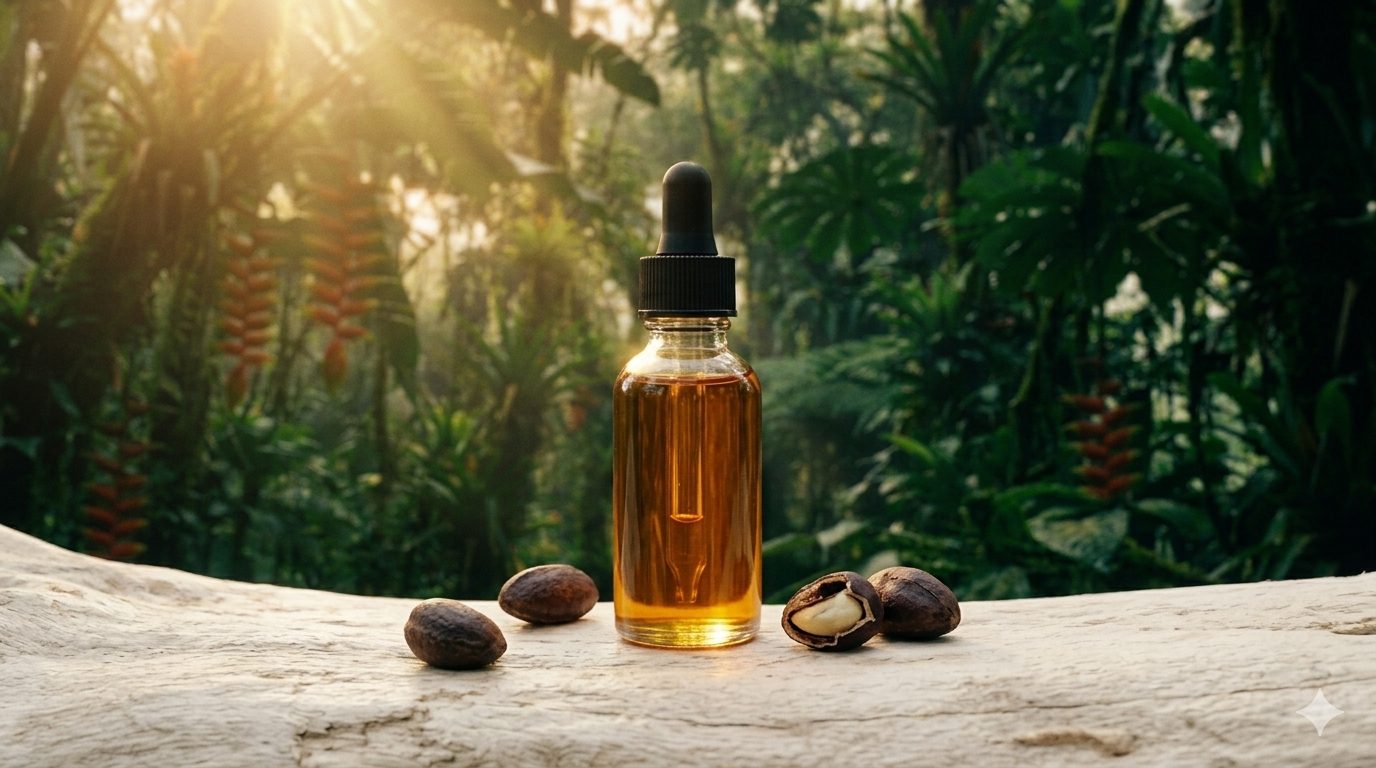
In the pursuit of botanical excellence, there exists a persistent tension between abundance in nature and accessibility in markets. While the shelves of European apothecaries are well-acquainted with the golden hues of argan and the pale rose of rosehip, a more potent substance remains conspicuously absent from the high-street vitrine: cacay oil.
The scarcity of cacay is not a failure of interest, but a testament to a landscape that has, until recently, refused to be rushed — and to the particular blindness of a global market that has historically required an ingredient to be already famous before it considers it worth knowing.
"To understand why cacay remains a ghost in the retail corridors of Paris or Berlin is to understand the geography of the Amazonian Orinoquía."
The Geography
of Rarity
Caryodendron orinocense is native to the lowland tropical forests of Colombia, Venezuela, Ecuador, Peru, and Brazil — specifically the drainage basins of the Amazon and Orinoco rivers, at altitudes below 800 metres, with annual rainfall above 2,000mm. The tree grows to 30–40 metres in its natural habitat. It begins producing fruit between the ages of four and seven years. A single mature tree can yield 100–250 kilograms of nuts annually.
Unlike the industrial-scale harvests that fuel global demand for argan — grown in concentrated regions of Morocco under increasingly commercial conditions — cacay has historically operated at an entirely different scale. For decades the tree was marginalised, cleared for timber or lost to cattle grazing as the Amazon's agricultural frontier expanded. Only recently has a regenerative value chain begun to emerge: one that recognises the tree's economic value as a reason to keep it standing.
The logistics of traditional cacay sourcing are inherently artisanal. Wild-harvested nuts are collected by local communities — including the Piaroa and Yukpa peoples of the Orinoco, who have used the oil medicinally for generations — and cold-pressed with care to preserve a nutrient profile that heat processing would degrade. Because wild production is decentralised and seasonal, yield is finite and consistent industrial supply has been difficult to establish.
The Plantation Alternative
A parallel and growing supply pathway has changed this picture considerably. Certified organic cacay plantations — established primarily in Colombia's Meta, Caquetá, and Putumayo departments — now produce cacay oil at scale without requiring wild extraction. These cultivated trees are managed within agroforestry systems: planted alongside native species, farmed by local rural communities, and certified under organic standards that prohibit synthetic inputs.
The plantation model offers what wild harvesting cannot: year-round production, full traceability from seed to oil, and verifiable organic certification. A plantation tree produces its first fruit within four to seven years and yields up to 250 kilograms of nuts annually at maturity. For brands committed to both sourcing ethics and supply reliability, certified organic cacay plantations represent the most rigorous path to the ingredient. Walden Organics sources from certified organic crops in Colombia — traceable, cold-pressed, and unrefined.
What this dual supply chain — wild harvest and plantation — means for the future of cacay is significant. The wild-harvested model preserves cultural practice and forest biodiversity. The plantation model provides the economic stability and certification that allow the ingredient to enter formulations at scale without compromising on standards. Both have their place. Both require that the tree remains standing.
A Concentration of
Biological Intelligence
Should you encounter this still-rare oil, its scarcity is immediately justified by its composition. Cacay is an outlier — a substance of such nutritional density that it renders its more famous contemporaries surprisingly modest by comparison.
The Chemical Architecture — Key Actives
Vitamin E (α-tocopherol)
~113mg per 100g — triple the vitamin E of argan oil (~32mg/100g), and significantly higher than rosehip. The skin's primary lipid-phase antioxidant: neutralises free radicals before they reach the cellular membrane. Essential defence against UV, pollution, and the oxidative load of daily exposure.
Natural Retinol (Vitamin A)
Three times more than rosehip oil — and delivered in its natural plant matrix, alongside tocopherols that stabilise its effect. Facilitates cellular renewal and collagen synthesis without the inflammatory response associated with isolated synthetic retinol. Better tolerated by sensitive skin types precisely because it arrives as nature formulated it.
Linoleic Acid (Ω-6)
~70–75% of total fatty acid content — nearly twice the linoleic acid of argan oil (~35%) and higher than rosehip (~45–55%). An essential fatty acid the body cannot synthesise: it rebuilds the skin's lipid barrier from within, reduces inflammatory signalling, and is the specific compound most depleted in acne-prone and barrier-compromised skin.
Beta-Sitosterol
A third active mechanism — this phytosterol competes with cholesterol at the cellular level, reducing dermal inflammation and independently supporting collagen synthesis. The combination of retinol, linoleic acid, and beta-sitosterol in a single unrefined oil is rare. It is what makes cacay effective as a stand-alone treatment rather than merely a carrier oil.
The result is an oil that does not sit upon the skin but integrates with it — absorbed quickly, leaving a matte and supple finish that belies the depth of what has been delivered to the dermis. In clinical testing, consistent twice-daily application of 100% cold-pressed cacay oil over four weeks produced measurable reductions in wrinkle appearance in 95% of subjects and a 100% rate of improved hydration and firmness.
The Ritual
of Discovery
While argan and rosehip have become staples of the routine — items selected by convenience, habit, and the accumulated weight of marketing spend — cacay remains a ritual for the considered. It is for those who value the potency of the source over the familiarity of the name.
To use cacay is to participate in something more than a skincare decision. The certified organic plantation model means that a portion of its value returns directly to rural communities in the Colombian Amazon whose livelihoods have historically been threatened by deforestation and the urbanisation of the regional economy. The wild harvest model means the tree's continued survival depends on its economic relevance to the communities that live within its range.
In both cases, the act of choosing this oil — over a more recognised, more industrialised alternative — is a small but direct signal that what the forest produces is worth more standing than cleared.
"It is a rare substance, found not through the noise of the market, but through a deliberate search for what actually works."
Suggested Use
After evening cleansing, dispense two to three drops into clean palms. Warm the oil briefly between the hands — enough to feel the texture shift from liquid to something closer to silk — then press firmly into slightly damp skin, focusing on areas of dryness or visible fatigue. The moisture in the skin helps distribute the oil evenly and improves absorption of the linoleic acid into the barrier layer. For daytime use, follow with SPF: the retinol content, though naturally buffered, warrants sun protection as part of any vitamin-A-adjacent routine.
The Cacay Collection